


Scoliosis Results in Phoenix AZ
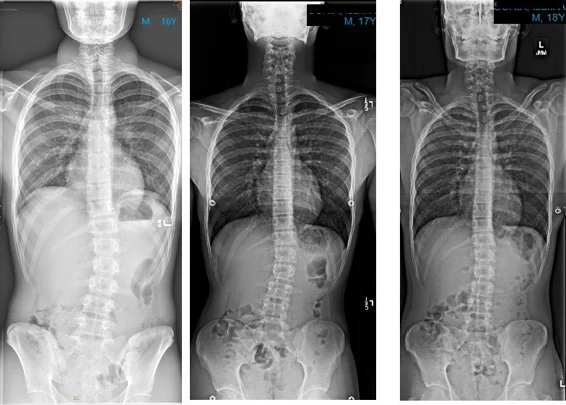
RESULT: 16M
- Initial Cobb angle: 21°
- Final Cobb angle: 5°
This 16-year-old male achieved a remarkable improvement after two years of treatment using our Scolio-Trainer® combined with a nighttime-only, over-corrective brace. His scoliosis improved from a 21° Cobb angle to just 5°, well below the 10° threshold used to define scoliosis. He and his parents were thrilled with the outcome. We will continue to monitor his progress to help ensure that the correction is maintained over time.
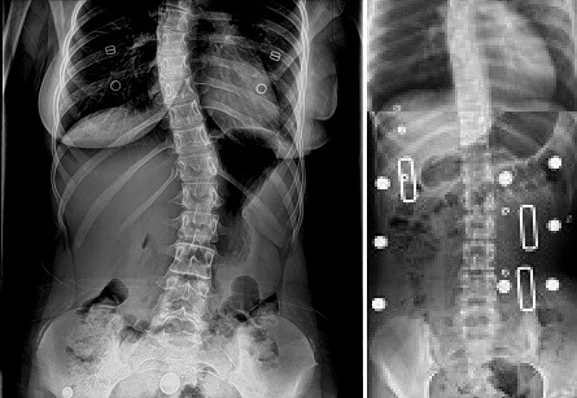
RESULT: 13F
- Initial Cobb angle: 27°
- In-brace Cobb angle: 0° - Full correction
This 13-year-old female demonstrates very good potential for scoliosis correction. Her in-brace X-ray will help demonstrate the degree of correction that can be achieved while properly positioned in the brace. Consistently following her recommended care plan and wearing her night-time-only, over-corrective brace as prescribed will give her the best opportunity for a successful outcome.
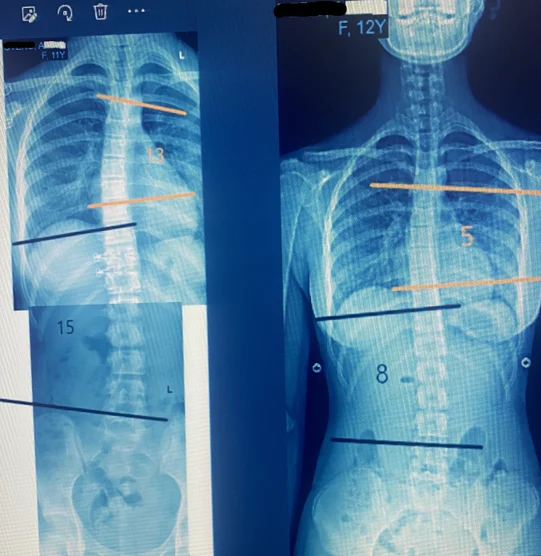
RESULT: 11F
- Initial Cobb angle: Thoracic 13° and Lumbar 15°
- After 1st Year treatment Cobb angle: Thoracic 5° and Lumbar 8°
This 11-year-old female’s parents chose to take a proactive approach after being advised elsewhere to “wait and watch” to see if her scoliosis progressed. Rather than waiting for the curve to worsen, they elected to begin conservative care early. After one year of care in our office, her spinal curve is now below the diagnostic threshold for scoliosis. Her progress highlights an important principle: early intervention, particularly during a child’s growing years, may provide a greater opportunity for meaningful improvement and help reduce the risk of progression.
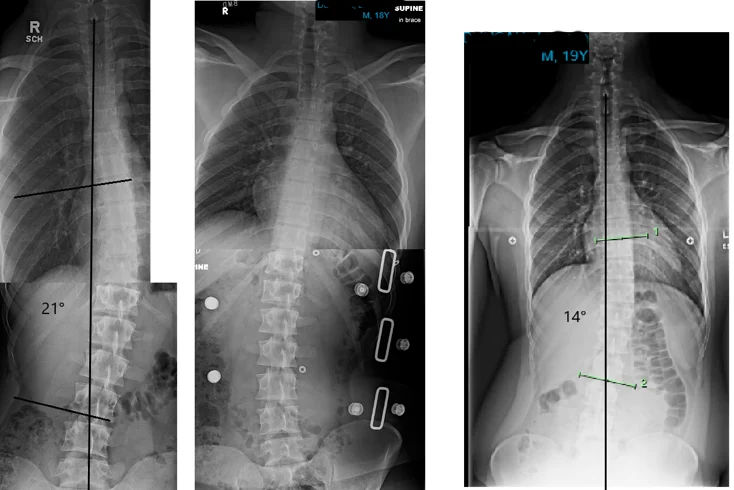
RESULT: 18M
- Initial Cobb angle: Thoraco-Lumbar 21°
- In-brace over correction: -16°
- After 1st Year treatment: Thoraco-Lumbar 14°
This 18-year-old X-rays revealed moderate scoliosis. After beginning treatment, his in-brace X-ray showed excellent correction and encouraging potential for improvement. After his first year of care, we were able to reduce his spinal curvature by 33%, bringing the curve down to 14°. This is a very positive result and demonstrates the improvement that may be possible with consistent, individualized scoliosis care.
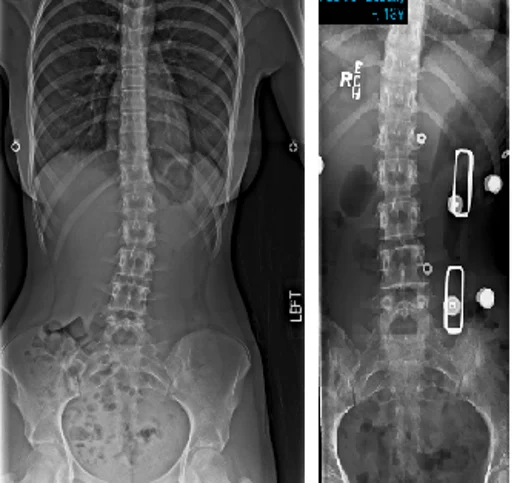
RESULT: 13F
- Initial Cobb angle: Thoraco-Lumbar 14°
- In-Brace Cobb angle: Thoraco-Lumbar - (13)° opposite direction
This patient is showing excellent potential for scoliosis correction, as her in-brace X-ray demonstrates a complete reversal of her scoliosis while wearing the brace. This is an encouraging indicator of the corrective potential of her spine.
She will continue with her treatment plan over the next several months, after which we will take a follow-up X-ray to evaluate how much lasting correction has been achieved. This case highlights the importance of early intervention. Beginning scoliosis care at a younger age, while the spine is still growing and more adaptable, may provide a greater opportunity for meaningful correction and better long-term outcomes.
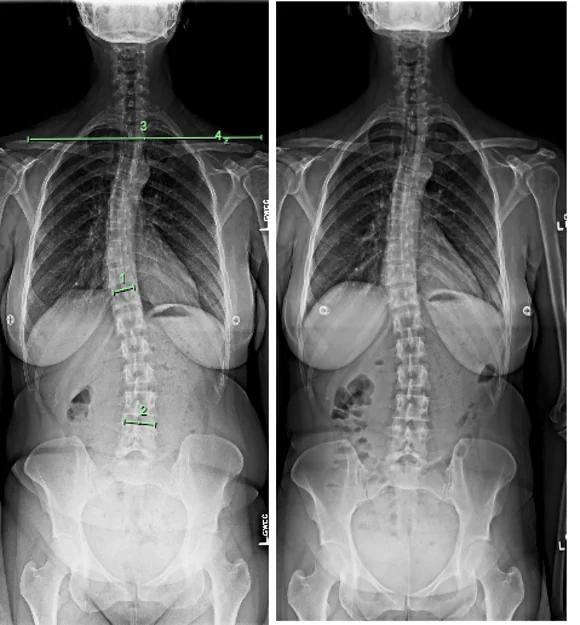
RESULT: 44F
- Initial Cobb angle: Thoracis 28° and Lumbar 18°
- After treatment Cobb angle: Thoracic 18° and Lumbar 7°
This 44-year-old woman had been living with scoliosis for many years and had previously been told that, because she was an adult, there was little that could be done to improve her spinal curves.
Following treatment in our office, her thoracic curve was reduced by 36% and her lumbar curve by 62%. Her lumbar curve improved to just 7°— below the 10° threshold used to define scoliosis.
She is extremely pleased with her progress and continues care with the goal of maintaining her improvements and pursuing additional correction where possible. Her results demonstrate that meaningful improvement may still be possible for adults with scoliosis.
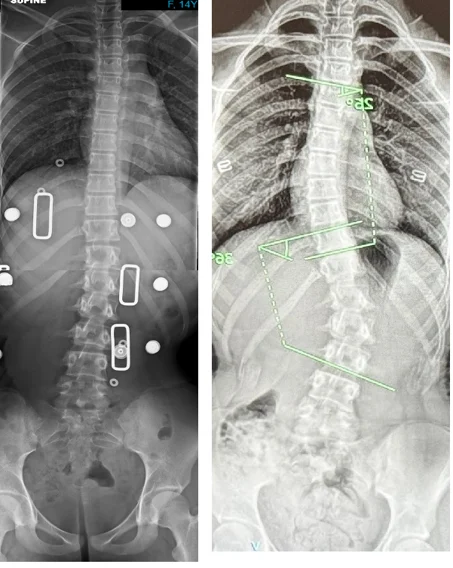
RESULT: 14F
- Initial Cobb angle: Thoracic 25° and Lumbar 36°
- In-Brace Cobb angle: Thoracic 5° and Lumbar 5°
This patient demonstrates excellent potential for scoliosis correction, with her in-brace X-ray showing nearly complete correction of her spinal curve while wearing the brace. This response is an encouraging sign of the corrective potential of her spine as she continues through treatment.
Her case also demonstrates the value of early intervention. Beginning scoliosis care while a child is still growing and the spine is more adaptable may provide a greater opportunity to achieve meaningful correction and improved long-term outcomes.
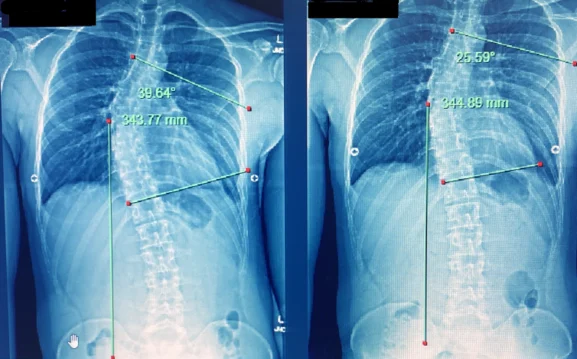
RESULT: 24M
- Initial Cobb angle: Thoracolumbar 40°
- After treatment Cobb angle: Thoraco-Lumbar 26°
This 24-year-old man had previously been advised to begin considering scoliosis surgery. After learning about the conservative treatment options available in our office, he decided to begin care with us.
After 18 months of treatment, his scoliosis curve improved by 35%, decreasing to 26°. He is extremely excited and encouraged by the progress he has made.
As we continue with his care, our goal is to build on these improvements and pursue additional correction where possible. His progress demonstrates that meaningful improvement may be possible for adults with scoliosis through a consistent, individualized treatment approach.
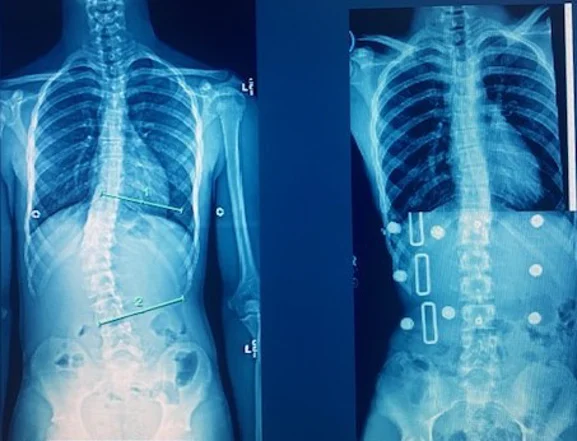
RESULT: 16M
- Initial Cobb angle: Lumbar 30°
- In-brace Cobb angle: Thoraco-Lumbar 0°
This 16-year-old young man demonstrates excellent potential for scoliosis correction, with his in-brace X-ray showing complete correction of his spinal curve while wearing the brace.
He will continue with his treatment plan, and we look forward to evaluating his progress with future X-rays. His strong in-brace response is an encouraging sign, and our goal is to achieve as much lasting correction as possible as his care progresses
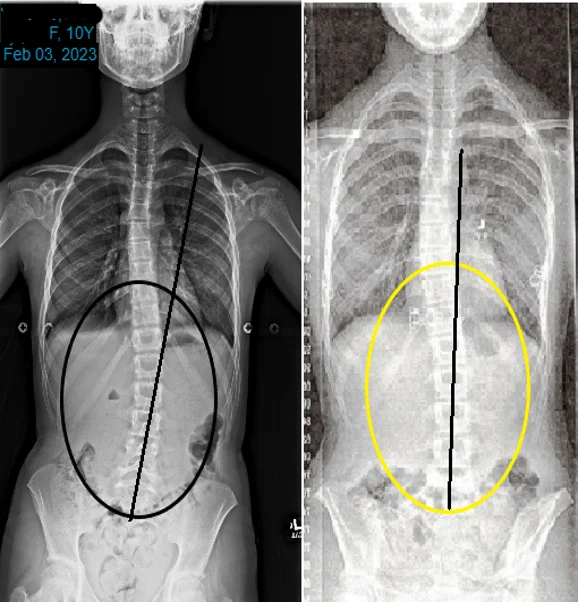
RESULT: 11F
- Initial Cobb angle: Thoracic 15° Lumbar 15°
- After treatment Cobb angle: Thoracic 9° Lumbar 5°
This 11-year-old young lady no longer meets the clinical criteria for scoliosis following care. Her treatment was completed without bracing, using the Scolio-Trainer® as part of her care plan. Her progress is another example of the potential benefits of being proactive and addressing scoliosis early, particularly while a child is still growing and the spine is more adaptable.
We will continue to carefully monitor her as she grows and progresses through future growth spurts, with the goal of maintaining her correction and identifying any changes early if they occur.
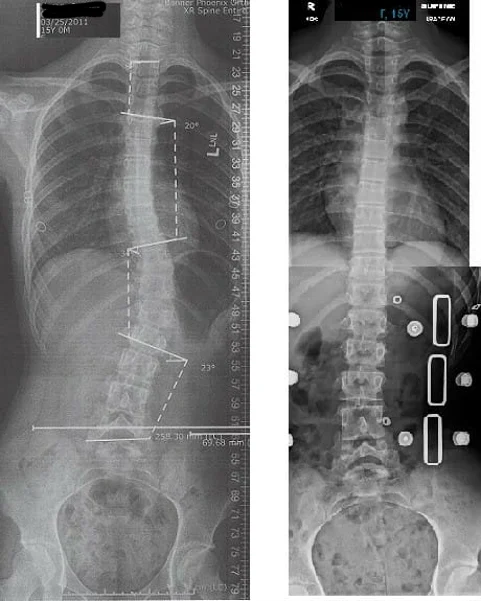
RESULT: 15F
- Initial Cobb angle: Thoracic 20°, Thoracolumbar 34°, Lumbar 23°
- In brace Cobb angle: Thoracic 4°, Thoracolumbar 4° and Lumbar 3° (all opposite direction overcorrection)
This 15-year-old patient demonstrates excellent potential for scoliosis correction. Her in-brace X-ray shows a significant response, with all three curves correcting beyond neutral into an opposite-direction overcorrection.
This encouraging result demonstrates the potential benefits of combining the Scolio-Trainer® with an over-corrective, nighttime-only brace as part of a comprehensive scoliosis treatment program.
We will continue to carefully monitor her progress as she grows and moves through future growth spurts, with the goal of maintaining her correction, supporting continued improvement, and identifying any changes early if they occur.
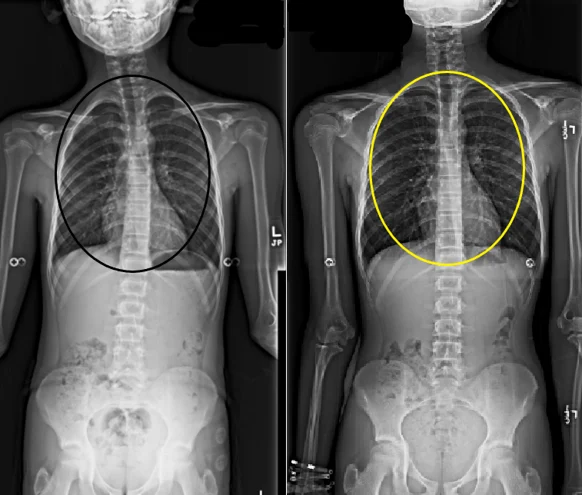
RESULT: 11F
- Initial Cobb angle: Thoracic 12°
- After treatment Cobb angle: Thoracic 0°
This 11-year-old patient initially presented with a 12° upper thoracic scoliosis curve. Her treatment plan included chiropractic adjustments, targeted exercises for the upper thoracic region, and an over-corrective brace primarily focused on the thoracolumbar area.
Following treatment, her thoracic Cobb angle improved from 12° to 0°, meaning her current measurement no longer meets the diagnostic threshold for scoliosis. This is an excellent outcome and demonstrates the potential benefits of identifying and addressing scoliosis early, particularly during the growing years.
We will continue to carefully monitor her spine as she grows and progresses through future growth spurts, with the goal of maintaining her correction and identifying any recurrence or changes as early as possible.
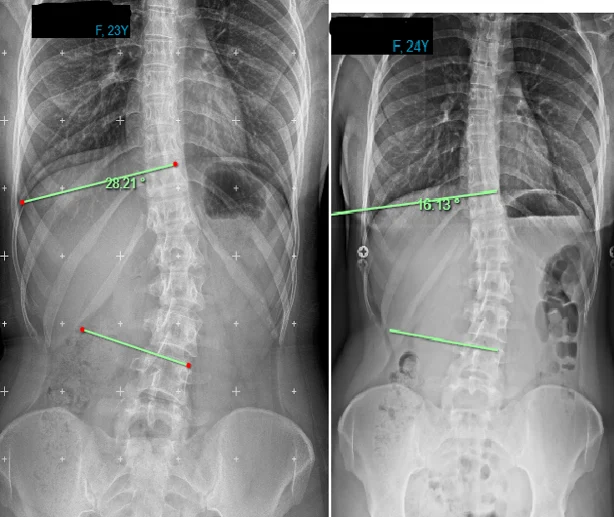
RESULT: 24F
- Initial Cobb angle: Thoracic 28°
- After treatment Cobb angle: Thoracic 16°
This 24-year-old patient had previously been told that because she was past her growing years, there was little that could be done to improve her adult scoliosis. She came to our office looking for a conservative treatment option.
After just one year of treatment, her thoracic Cobb angle decreased from 28° to 16°—a 43% reduction in curve magnitude.
This is an encouraging outcome and demonstrates that meaningful changes may be possible in some adults with scoliosis, even after skeletal maturity. Her treatment program incorporated the Scolio-Trainer® along with an over-corrective nighttime brace. We’ll continue her care and carefully monitor her progress, with the goal of maintaining the correction achieved and pursuing additional improvement where possible.
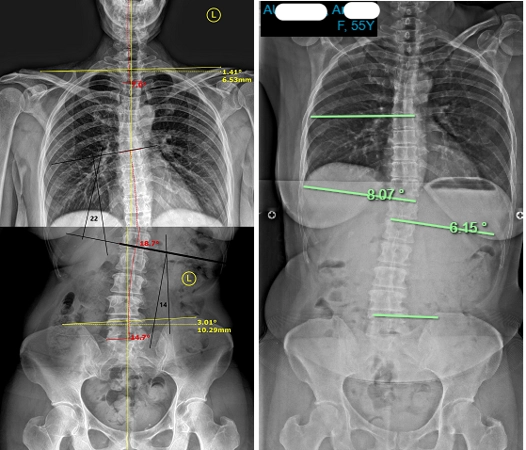
RESULT: 55F
- Initial Cobb angle: Thoracic 22° Lumbar 14°
- After 1 year treatment Cobb angle: Thoracic 8° Lumbar 6°
This 55-year-old patient had previously been told that, because she was an adult, there was little that could be done to improve her scoliosis. She came to our office seeking a conservative, non-surgical treatment option.
After one year of treatment, her thoracic Cobb angle decreased from 28° to 16°—a 43% reduction in curve magnitude. Her progress is especially encouraging because it demonstrates that meaningful improvement may be possible for some adults with scoliosis, even after skeletal maturity. Her treatment program combined the Scolio-Trainer® with an over-corrective nighttime brace to address her individual spinal curvature.
We will continue her care and carefully monitor her progress, with the goal of maintaining the correction already achieved and working toward additional improvement where possible.
Individual results vary. Treatment outcomes cannot be predicted or guaranteed.